Why Disaster Recovery Cloud Provider Matters
- Disaster Recovery Cloud Provider strategies are critical when deciding whether to keep DR on the same cloud service provider.
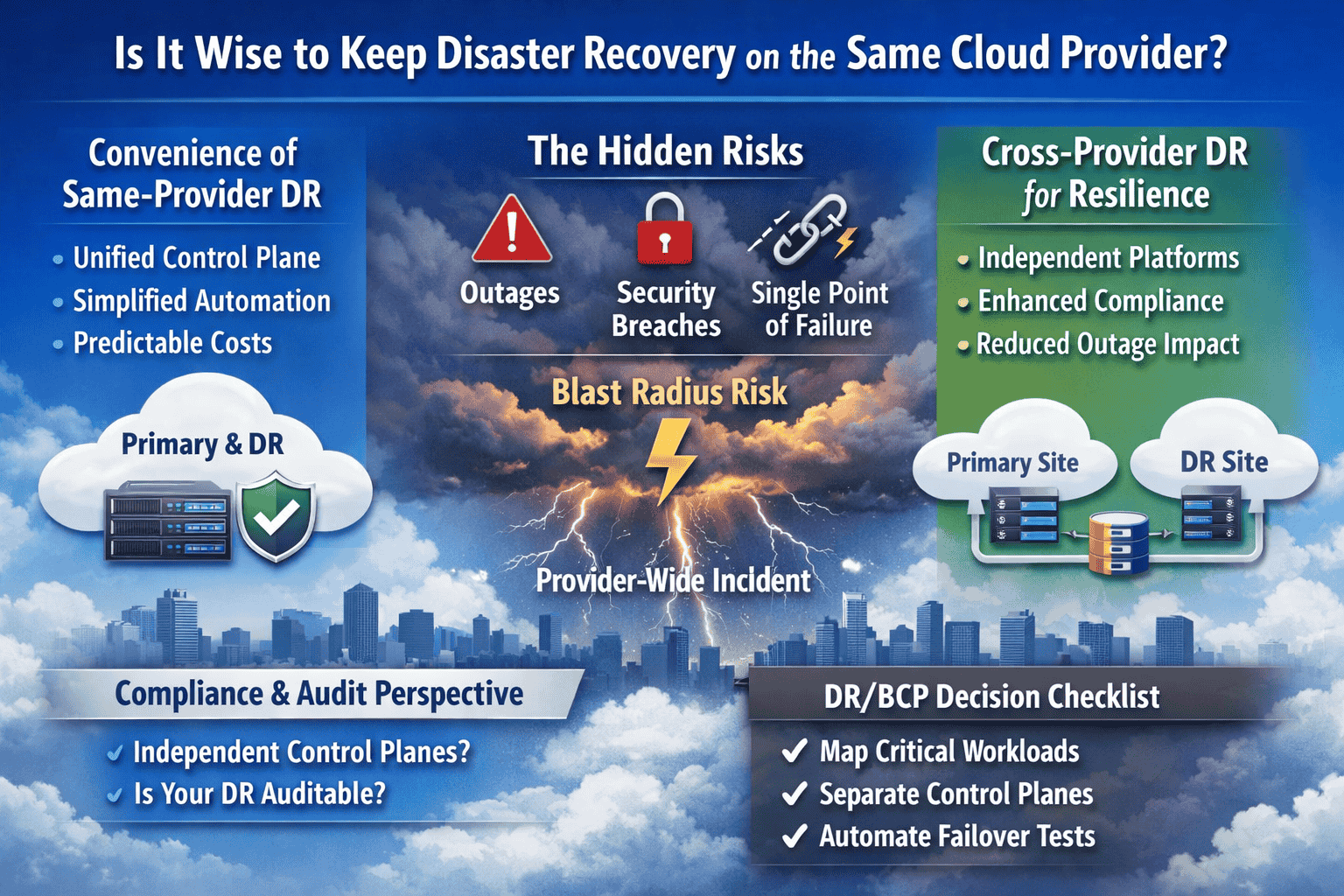
- Convenience vs systemic risk: Single‑provider DR reduces operational friction (one control plane, unified IAM, simpler runbooks) but increases blast radius if the provider suffers a multi‑service or multi‑region outage. Recent large outages show how configuration or DNS failures can cascade across services.
- Multi‑cloud reduces correlated failure risk but adds complexity, cost, and governance overhead. Use multi‑cloud where business impact and compliance require independent control planes
- Provider outages and cascading failures have occurred and can propagate across regions and services, creating a real risk if both primary and DR are on the same provider.
- Misconfiguration and supply‑chain incidents are common root causes of cloud breaches; a single‑provider DR does not eliminate these risks and can amplify impact.
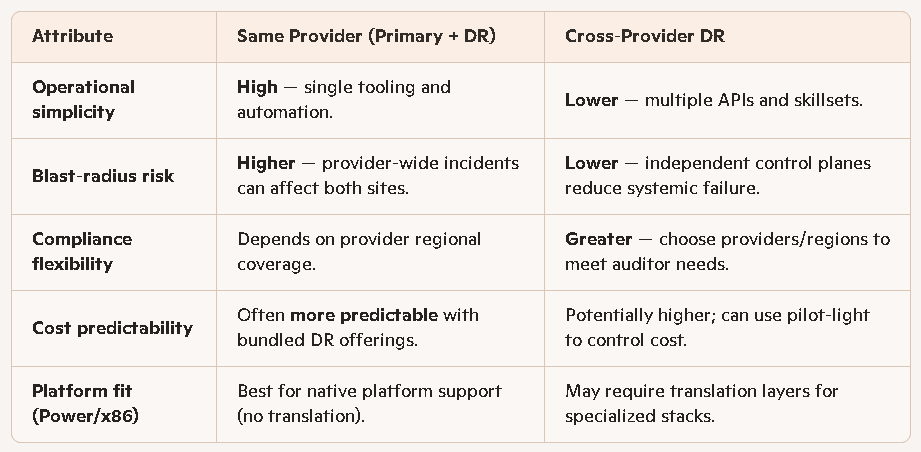
Comparative snapshot:
Decision guide — how to choose
- Map workloads by platform and criticality. Keep native platform workloads (specialized OS/hypervisor) on providers that support them natively to avoid fragile conversions. Bold: native support reduces RTO/RPO risk.
- Classify risk tolerance. If RTO/RPO and regulatory exposure are critical, plan cross‑provider DR for those workloads.
- Design administrative separation. Even within one provider, ensure separate admin accounts, networks, and billing to reduce shared‑control failures.
- Adopt mixed models:
- Platform‑native DR for legacy/Power workloads (single provider where necessary).
- Cross‑provider DR for the most critical services (pilot‑light or warm standby on a second provider).
One‑page checklist
- Map workloads by criticality, RTO/RPO, and platform (Power vs x86).
- Compliance matrix: list regulations, residency, encryption, audit evidence required.
- DR model per tier: Backup/Restore; Pilot‑Light; Warm Standby; Multi‑Active.
- Control‑plane separation: separate admin accounts, keys, billing, and monitoring.
- Network isolation: distinct VPCs/VNets and separate routing for DR.
- Failover automation & tests: scripted runbooks, quarterly drills, auditor visibility.
- Pilot‑light on alternate provider for top‑tier workloads (cost‑efficient resilience).
- Cost vs risk review: quantify business impact of downtime and model DR TCO.
- Third‑party audit readiness: package evidence, logs, and test reports for auditors.
- Governance: assign DR owner, runbook owner, and audit liaison.
GCC Regulatory Alignment
- For GCC-regulated institutions, IBM Cloud same-provider DR offers clear compliance positioning:
- SAMA (Saudi Arabia): Mandates that DR sites are geographically separated from production. IBM Cloud Chennai-to-Dallas satisfies geographic separation requirements.
- CBUAE (UAE): Requires documented BCP with tested failover capabilities. IBM Cloud GRS provides automated replication logs and AXASCLOUD provides quarterly DR test reports.
- QFCRA (Qatar): Financial institutions require offsite DR with defined RTO and RPO. IBM Cloud PowerVS GRS meets these requirements with documented SLAs.
Practical trade‑offs and mitigations
- Complexity vs resilience: Multi‑provider DR increases operational complexity but materially reduces systemic risk. Use automation, IaC, and runbooks to manage complexity.
- Cost control: Use pilot‑light or warm‑standby models on the secondary provider to balance cost and readiness.
- Recommended checklist (actionable)
- Compliance matrix per workload.
- Platform fit assessment (native Power/x86 support).
- Isolation plan (separate admin, network, keys).
- Automated failover runbooks + scheduled tests.
- Pilot‑light secondary environment on alternate provider for top‑tier workloads.
- Regular tabletop exercises and configuration drift detection.
Frequently Asked Questions
Does IBM Cloud PowerVS GRS replicate all storage types?
IBM GRS replicates Tier 1 (NVMe) and Tier 3 (SSD) PowerVS storage volumes. It does not replicate Tier 5 (Standard) volumes. AXASCLOUD will assess your storage configuration and recommend the appropriate tier for DR-eligible volumes during the design phase.
What IBM Cloud regions are paired for GRS replication?
IBM Cloud provides paired regions for GRS. As of 2026, Chennai (che01) is paired with Dallas (dal) for cross-region replication — relevant for GCC organisations using Chennai as their primary PowerVS site. Other pairs include London–Frankfurt, Washington–Toronto, and Sydney–Osaka.
Can we test failover without impacting production?
“Yes. AXASCLOUD configures isolated DR test workspaces within the DR IBM Cloud account. Testing uses a clone of the replicated data volumes and runs in a separate network segment, ensuring zero impact to production.
What is the cost of IBM Cloud GRS replication?
IBM GRS is charged based on the volume of storage replicated and the egress traffic between regions. For most enterprise PowerVS deployments, GRS replication adds 15–25% to the total storage cost. AXASCLOUD provides detailed cost modelling during the architecture assessment.
How long does failover take in a same-provider PowerVS DR?
With IBM GRS replication and AXASCLOUD’s automation scripts, a typical PowerVS AIX failover completes in 90–120 minutes. Oracle RAC and SAP HANA failovers may require 2–4 hours depending on application restart sequences.
Is same-provider DR more vulnerable to provider-wide outages?
This is a valid concern. IBM Cloud operates independent regional infrastructure, meaning a Chennai outage does not affect Dallas. However, for organisations with zero tolerance for provider dependency, AXASCLOUD can design a hybrid DR strategy — production in IBM Cloud Chennai, with a secondary DR site on a separate provider or on-premises. We recommend discussing your risk tolerance during the initial assessment.
Some interesting blogs to read…
- Why Most Disaster Recovery Strategies Failed During the AWS Outage
- Disaster Recovery with IBM Power Virtual Server
- High Availability and Disaster Recovery options in IBM data center
Home » Is It Wise to Keep Disaster Recovery (DR) on the Same Cloud Service Provider? » DR on the Same Cloud Service Provider?
IBM Cloud PowerVS DRaaS for Critical Workloads -Disaster Recovery as a Service
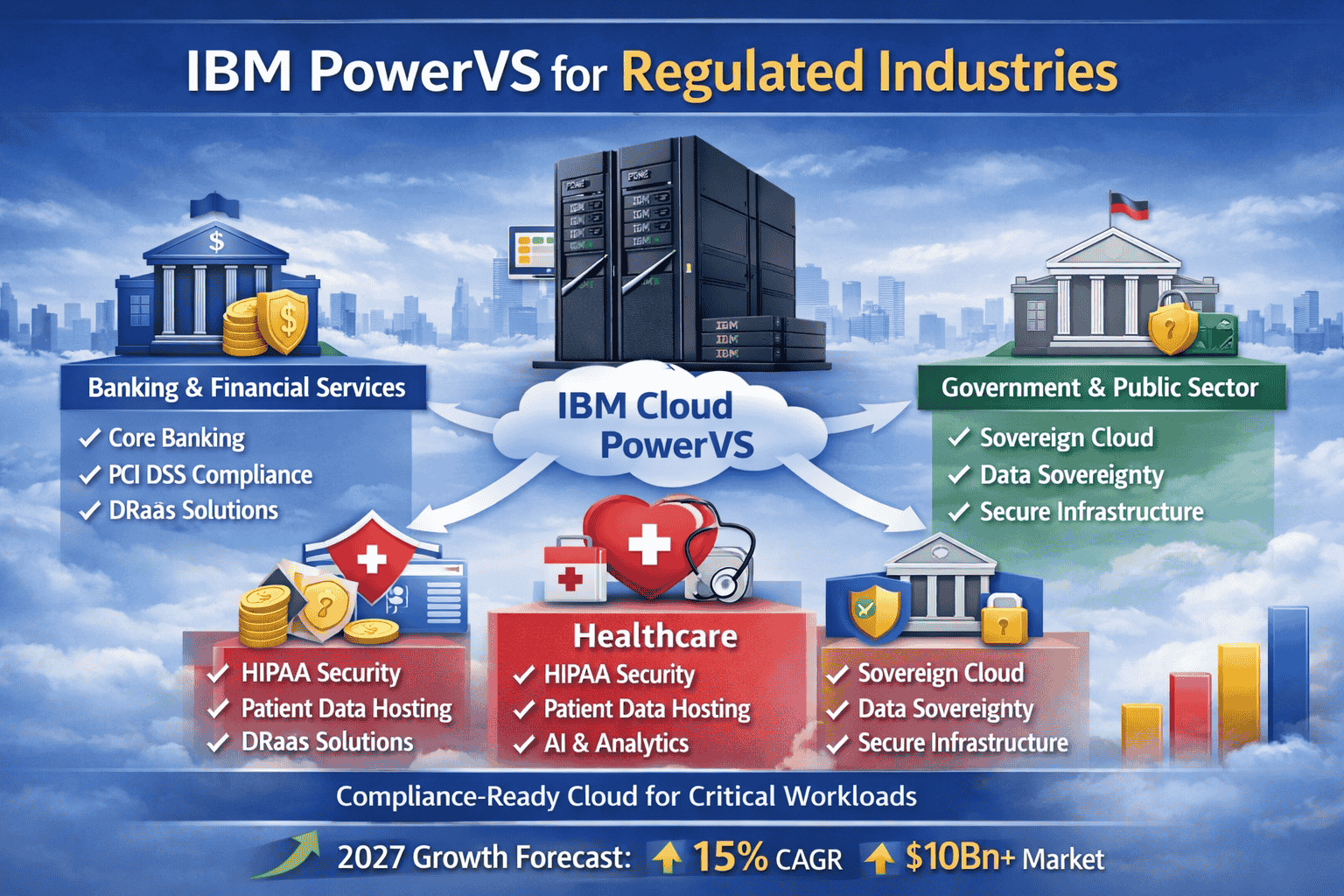
Market Analysis – IBM Cloud PowerVS for Regulated Industries