Why Disaster Recovery Cloud Provider Matters
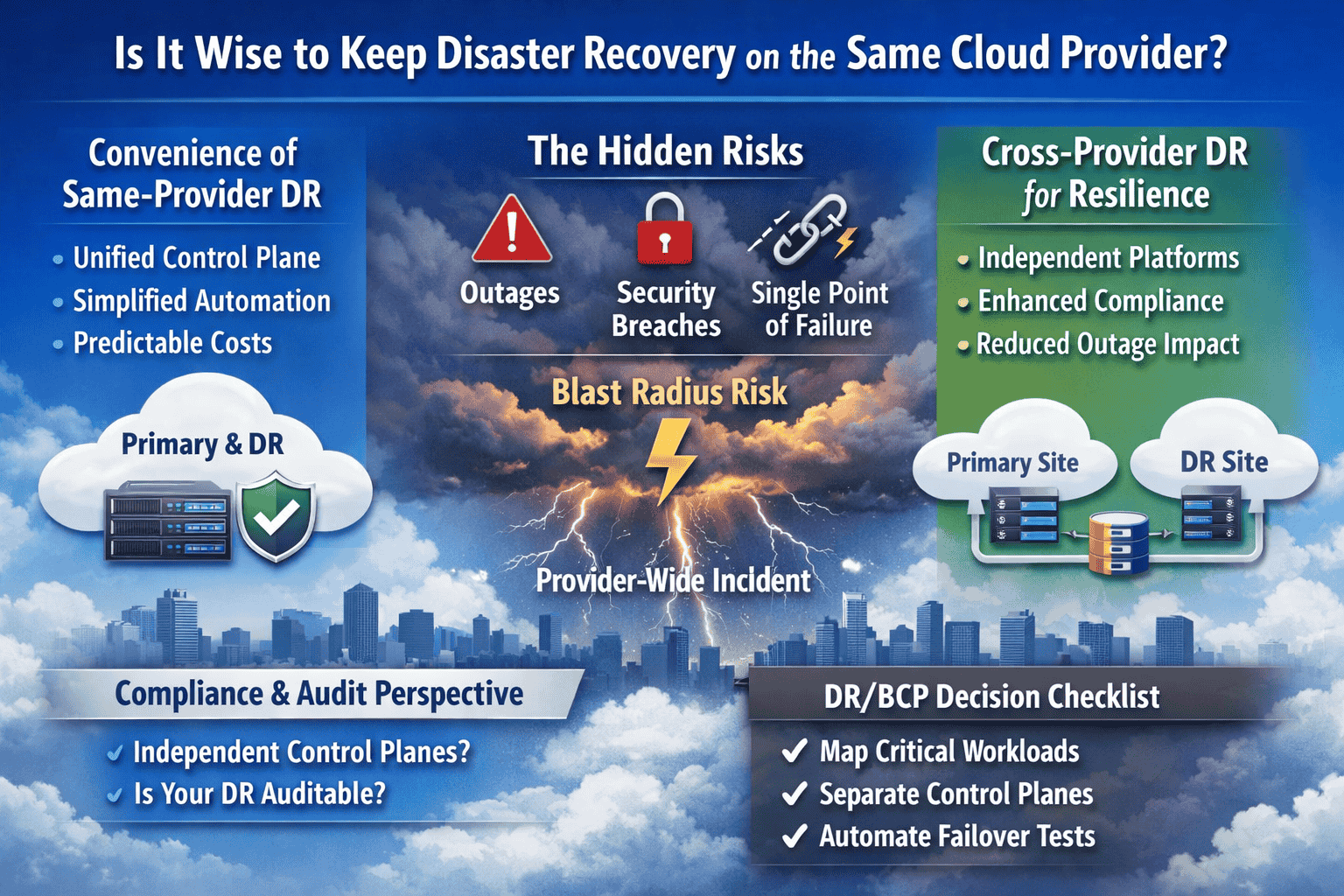
- Disaster Recovery Cloud Provider strategies are critical when deciding whether to keep DR on the same cloud service provider.
- Convenience vs systemic risk: Single‑provider DR reduces operational friction (one control plane, unified IAM, simpler runbooks) but increases blast radius if the provider suffers a multi‑service or multi‑region outage. Recent large outages show how configuration or DNS failures can cascade across services.
- Multi‑cloud reduces correlated failure risk but adds complexity, cost, and governance overhead. Use multi‑cloud where business impact and compliance require independent control planes
- Provider outages and cascading failures have occurred and can propagate across regions and services, creating a real risk if both primary and DR are on the same provider.
- Misconfiguration and supply‑chain incidents are common root causes of cloud breaches; a single‑provider DR does not eliminate these risks and can amplify impact.
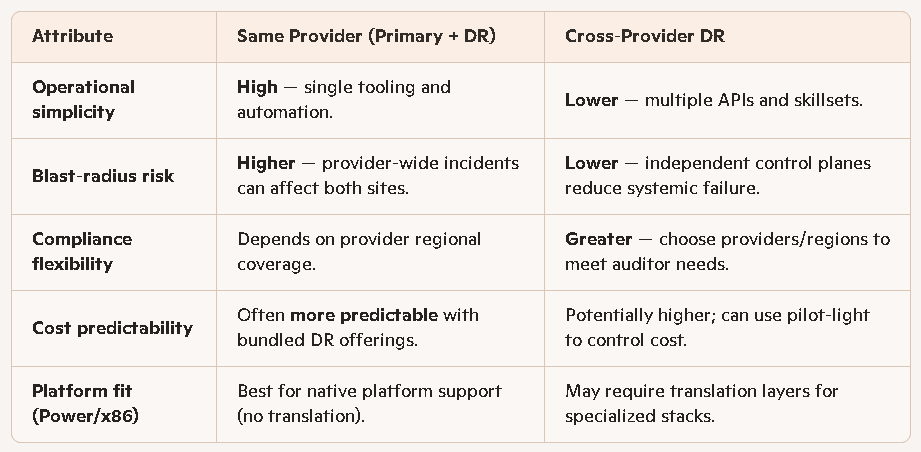
Comparative snapshot:
Decision guide — how to choose
- Map workloads by platform and criticality. Keep native platform workloads (specialized OS/hypervisor) on providers that support them natively to avoid fragile conversions. Bold: native support reduces RTO/RPO risk.
- Classify risk tolerance. If RTO/RPO and regulatory exposure are critical, plan cross‑provider DR for those workloads.
- Design administrative separation. Even within one provider, ensure separate admin accounts, networks, and billing to reduce shared‑control failures.
- Adopt mixed models:
- Platform‑native DR for legacy/Power workloads (single provider where necessary).
- Cross‑provider DR for the most critical services (pilot‑light or warm standby on a second provider).
One‑page checklist
- Map workloads by criticality, RTO/RPO, and platform (Power vs x86).
- Compliance matrix: list regulations, residency, encryption, audit evidence required.
- DR model per tier: Backup/Restore; Pilot‑Light; Warm Standby; Multi‑Active.
- Control‑plane separation: separate admin accounts, keys, billing, and monitoring.
- Network isolation: distinct VPCs/VNets and separate routing for DR.
- Failover automation & tests: scripted runbooks, quarterly drills, auditor visibility.
- Pilot‑light on alternate provider for top‑tier workloads (cost‑efficient resilience).
- Cost vs risk review: quantify business impact of downtime and model DR TCO.
- Third‑party audit readiness: package evidence, logs, and test reports for auditors.
- Governance: assign DR owner, runbook owner, and audit liaison.
Practical trade‑offs and mitigations
- Complexity vs resilience: Multi‑provider DR increases operational complexity but materially reduces systemic risk. Use automation, IaC, and runbooks to manage complexity.
- Cost control: Use pilot‑light or warm‑standby models on the secondary provider to balance cost and readiness.
- Recommended checklist (actionable)
- Compliance matrix per workload.
- Platform fit assessment (native Power/x86 support).
- Isolation plan (separate admin, network, keys).
- Automated failover runbooks + scheduled tests.
- Pilot‑light secondary environment on alternate provider for top‑tier workloads.
- Regular tabletop exercises and configuration drift detection.
Some interesting blogs to read…
- Why Most Disaster Recovery Strategies Failed During the AWS Outage
- Disaster Recovery with IBM Power Virtual Server
- High Availability and Disaster Recovery options in IBM data center
Home » Is It Wise to Keep Disaster Recovery (DR) on the Same Cloud Service Provider? » DR on the Same Cloud Service Provider?